.webp)
Process
Some projects feel chaotic from the first week; others move from idea to launch almost calmly. The difference is often not talent but a shared picture of how the work is supposed to flow. That picture has a name: the product development life cycle.
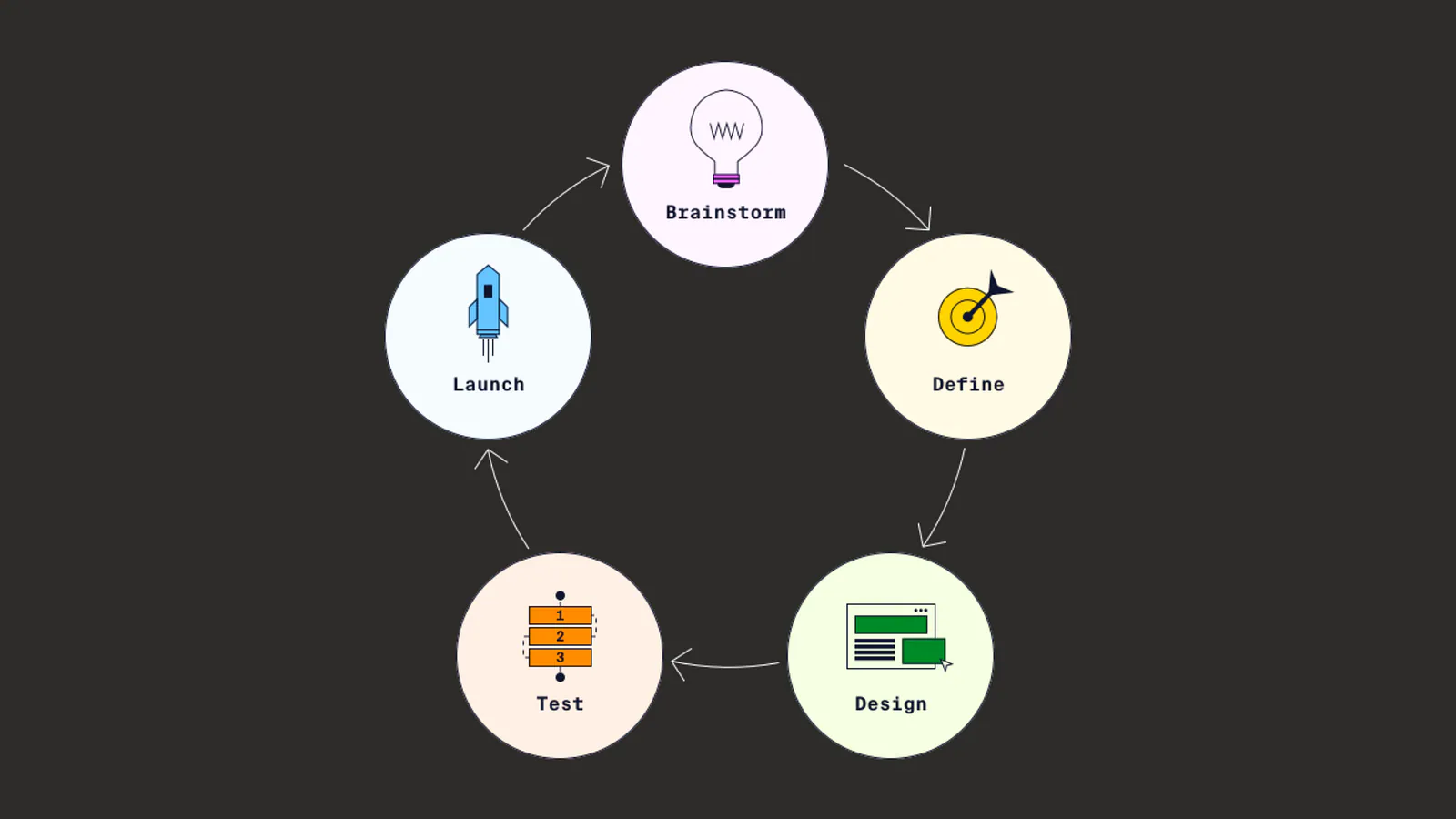
It is a cross-team, repeating process for taking a product from a first idea to the market and beyond. Unlike the old waterfall model, it assumes the path is not straight. People from different disciplines keep adjusting as they learn more about users and the market.
Why a designer should care
Design never happens in isolation. A designer who knows the whole cycle sees how each choice affects strategy, communicates better with product managers and developers, and keeps the work tied to real user problems rather than personal taste.
Stage 1: Brainstorm
The team generates possible answers to a well-defined problem. This is structured ideation, fed by market research, user research, competitor analysis and an honest view of what is technically possible.
A designer’s job here is to help the group explore options that are both fresh and realistic. The temptation is to jump to a solution. Resist it, and stay with the problem until it is properly understood.
Stage 2: Define
Ideas turn into a plan everyone shares. By the end there should be a clear vision with measurable goals, personas and use cases, a prioritised feature list with reasons, success metrics, and the technical limits.
The designer turns research into requirements that can be acted on. Skip this and you will spend weeks redesigning features that never matched what users or the business needed.
Stage 3: Design
Concepts become interfaces people can use. The work usually moves through four steps, each more detailed than the last.
- Sketches: quick, rough ideas about layout and function.
- Wireframes: structural blueprints that show how content is organised.
- Prototypes: interactive models that simulate the experience.
- Final interface: polished designs ready for developers.
Low-fidelity work keeps the focus on flow and structure, medium adds detail to interactions and content, and high-fidelity shows the finished look. Along the way the designer is also solving usability problems, checking accessibility and making sure the result can be built efficiently.
Stage 4: Test
Before launch, the team checks that the product works as intended and delivers value. Several kinds of testing feed back into design.
- Internal testing of early prototypes with the team.
- Usability testing, watching real people try to complete tasks.
- A/B testing to compare approaches.
- Accessibility testing to confirm the design works for everyone.
- Performance testing across devices and conditions.
Treat this stage as validation, not criticism. Problems found here cost far less to fix than the same problems found after launch.
Stage 5: Launch, and after
Going live is where real data begins. Behaviour appears in analytics, new problems and opportunities show up, and the market keeps moving. The designer reads feedback, watches how the design performs and helps plan the next round. Launch is not a finish line; it is where improvement based on evidence starts.
Why it is a loop
User needs change, competitors move, new technology opens options and business priorities shift. Good products keep cycling through the stages as a result. Designers who accept that are always learning and rarely left behind.
What changes for you
- Collaboration improves, because you understand the pressures other roles face.
- You contribute to strategy and not only to screens.
- You solve problems with a framework instead of intuition alone.
- Designers with this wider view are better placed for senior and leadership roles.
Putting it into practice
- Begin every project by understanding the problem, not by sketching.
- Get involved in user research and market analysis.
- Document how each design decision connects to a user need or business goal.
- Hold regular check-ins with product managers and developers.
- Build testing and revision into the timeline from the start.
- Track how your designs perform after launch.
Look at your current project and decide which stage it is in, what comes next and how you can help with the whole of it. That habit is what separates someone who executes tasks from a design partner who shapes the product.